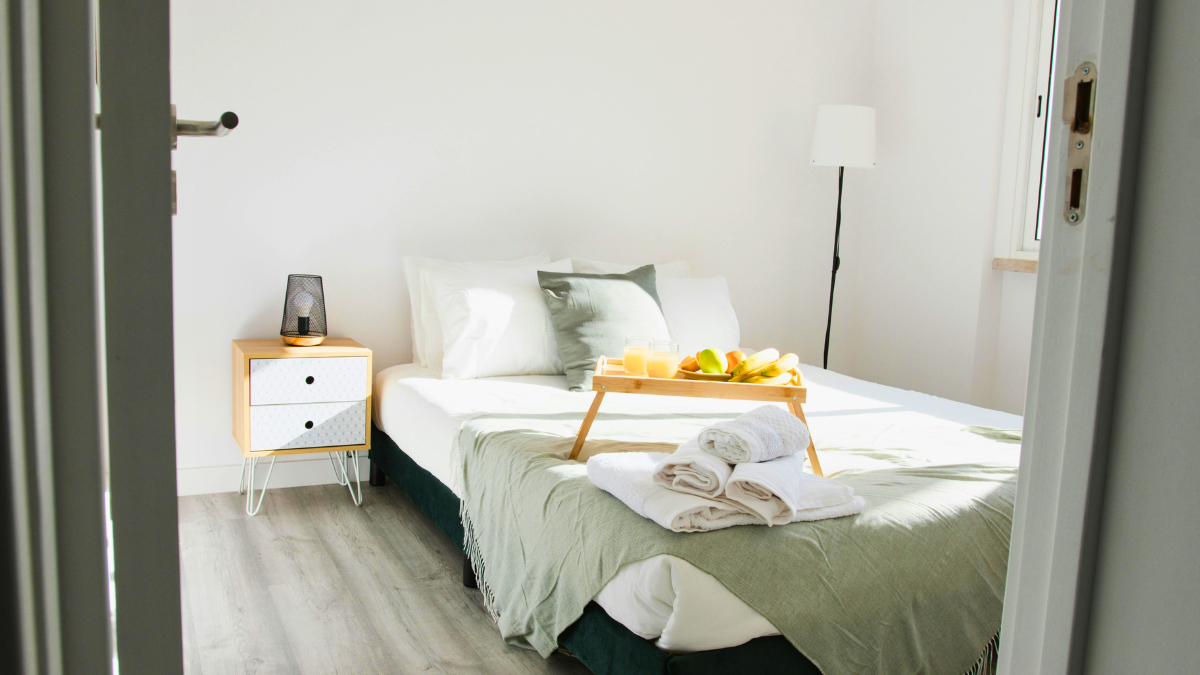
Putting your flat on Airbnb can seem like a fairly ordinary thing to do. Perhaps you are going away for a few weeks, spending part of the year elsewhere or simply wondering whether the spare time between visits could earn some money.
Then somebody mentions the lease.
For a leaseholder, that can change the picture completely. Your lease may restrict underletting, require the freeholder’s consent, insist that the flat is used only as a private residence or contain other wording that catches short-term occupation. And even where the lease presents no problem, planning rules, your mortgage and insurance may do.
The slightly awkward truth is that there is no universal answer to the question, “Can I Airbnb my leasehold flat?” Two flats next door to one another can be subject to different leases and therefore different rules.
This guide explains what to look for before listing a leasehold flat on Airbnb, Booking.com or another short-term letting platform in England or Wales.
Quick answer: Can I Airbnb my leasehold flat?
Possibly, but you should check your lease before accepting any bookings.
A lease may prohibit short-term letting outright, allow underletting only with the freeholder’s consent or require the property to be used as a “private residence” or “private dwelling”. The courts have held that Airbnb-style stays by a succession of short-term paying guests can breach this type of residential-use covenant.
Do not assume that a clause allowing ordinary subletting automatically allows Airbnb. Equally, an Airbnb stay is not necessarily a “subletting” in every legal sense: depending on the arrangement, it may amount to a tenancy or a licence. That is why the lease needs to be read as a whole.
Planning rules also matter. Greater London has its familiar 90-night rule, while Wales has a separate planning regime for short-term lets. Mortgage conditions, buildings insurance and other regulatory requirements should be checked too.
Contents
- What does your lease say about Airbnb?
- Does Airbnb count as subletting?
- Can a private residence clause prevent Airbnb?
- Do you need the freeholder’s consent?
- What if the lease says nothing about Airbnb?
- What are the planning rules in England?
- What are the planning rules in Wales?
- What else should you check?
- What if you are already using the flat as an Airbnb?
- What can the freeholder do if you breach the lease?
- Frequently asked questions
What does your lease say about Airbnb?
The lease is the starting point. But if it was written in 1985, you can search every page without finding the word “Airbnb”. That does not mean Airbnb is allowed.
If I were checking a lease for this issue, I would look particularly at the clauses dealing with underletting, subletting, parting with or sharing possession, occupation by other people, use as a private residence or dwelling, business use and nuisance.
These provisions are sometimes found in different parts of the document. That matters. A lease might appear to allow underletting but contain a separate user covenant that prevents the sort of transient occupation involved in weekend or holiday stays.
This is one of the peculiarities of leasehold ownership. You can own a valuable flat with another 100 years on the lease and still have contractual restrictions on how you use it. My broader leasehold property guide explains how lease covenants fit into leasehold ownership more generally.
The same principle explains why a lease can restrict keeping pets in a leasehold flat or require permission before altering a leasehold property. Owning the lease does not mean that every use of the flat is unrestricted.
Does Airbnb count as subletting?
Sometimes, but the label should not be allowed to obscure the real question.
A traditional residential subletting normally involves granting another person a tenancy. An Airbnb booking may create a tenancy in some circumstances, but other short-stay arrangements may amount to a licence to occupy instead.
That distinction can be legally important, but many leases use wording deliberately wide enough to catch both. A clause might prohibit not only “underletting” but also “parting with possession”, “sharing possession” or “permitting any other person to occupy” the flat.
So a leaseholder should be wary of reasoning that, because an Airbnb guest is technically a licensee rather than a tenant, a restriction on short-term occupation cannot apply. The answer depends on the precise covenant and what actually happens during the stay.
This is one reason I would read the user and occupation clauses alongside the underletting provisions rather than treating “Does my lease allow subletting?” as the whole enquiry.
Can a private residence clause prevent Airbnb?
Yes. For many leasehold flats, this is the crucial point.
A lease may say that the property can be used only as a “private residence”, “private dwelling” or “private dwelling house”. Those words can prevent very short stays by a succession of paying visitors even where another clause allows some forms of residential letting.
Nemcova v Fairfield Rents Ltd
In Nemcova v Fairfield Rents Ltd [2016] UKUT 303 (LC), the lease required the flat to be used as a private residence. The leaseholder granted a series of short-term lettings to people staying for a few days or weeks.
The Upper Tribunal decided that the covenant had been breached. The important feature was the lack of sufficient permanence in the guests’ occupation. The flat was accommodation for their stay, but it was not being used by them as their private residence in the sense required by the lease.
You can read the Nemcova decision on BAILII.
Triplerose Ltd v Beattie
The issue arose again in Triplerose Ltd v Beattie [2020] UKUT 180 (LC). The flat was advertised through Airbnb and Booking.com and used by short-term paying guests, often at weekends.
The lease was particularly interesting because it expressly contemplated some underletting. However, it also required the property to be used as a private dwelling house. The Upper Tribunal held that the short-term serviced accommodation breached that requirement.
The decision makes an important point: permission to grant residential tenancies is not necessarily permission to provide a succession of holiday or weekend stays. The person occupying the flat must still use it in the way required by the user covenant.
The Triplerose decision is also available on BAILII.
It is equally important not to turn those cases into a rule that every Airbnb breaches every residential lease. They do not. Lease interpretation always starts with the actual wording of the particular lease.
Do you need the freeholder’s consent?
That depends on the covenant.
An absolute covenant might simply say that the property must not be underlet. If so, there is no general rule entitling the leaseholder to insist that the freeholder makes an exception.
A qualified covenant might instead prohibit underletting without the landlord’s consent. Section 19(1)(a) of the Landlord and Tenant Act 1927 generally has the effect of making consent subject to a requirement that it is not unreasonably withheld.
Where the landlord is under a duty not to withhold consent unreasonably and receives a written application, the Landlord and Tenant Act 1988 imposes further duties concerning how the application is dealt with, including giving consent or refusal within a reasonable time and giving reasons for refusal.
You can read section 19 of the Landlord and Tenant Act 1927 and the Landlord and Tenant Act 1988 on legislation.gov.uk.
But there is an important sting in the tail. Even if consent to underlet cannot reasonably be withheld, the proposed letting may still breach another covenant. A landlord may, for example, have good reason to refuse consent to Airbnb-style occupation if the lease separately requires the flat to be used as a private residence.
And if permission is given, keep it. An email that seems unimportant today can become extremely useful when the flat is sold several years later.
Can the lease itself be changed?
Sometimes the obstacle is an absolute restriction that both leaseholder and freeholder are willing to change. That may require a formal variation rather than a one-off consent, particularly if the parties intend to alter the lease permanently.
My guide to a deed of variation of a lease explains how lease terms can be changed by agreement and when other parties, such as a mortgage lender, may need to be involved.
What if the lease says nothing about Airbnb?
If a lease contains no restriction on subletting, there is no general rule of leasehold law requiring the freeholder’s permission simply because the property is leasehold.
But do not stop reading there.
The lease may still contain a private-residence covenant, restrict other people from occupying the flat, prohibit parting with possession or impose conditions capable of catching short-term stays. A nuisance covenant can also matter if guests disturb neighbours, misuse common areas or repeatedly create security problems.
The government-funded Leasehold Advisory Service provides a useful independent guide to subletting and short-term lets.
I would also be cautious about treating a general prohibition on “business” use as an automatic Airbnb ban. In Triplerose, the Upper Tribunal found a breach of the private-dwelling covenant but did not find, on the facts and wording there, that the prohibition on carrying on a business “upon” the flat had been breached. Again, the precise words matter.
What are the planning rules in England?
Complying with the lease does not automatically mean that planning law allows the proposed use. They are separate questions.
Outside Greater London, there is currently no general statutory rule allowing every home in England to be used as a short-term let for 90 nights. Whether planning permission is required can depend on whether the nature and extent of the short-term letting amounts to a material change of use.
The safest approach where the use will be significant or regular is to check with the local planning authority.
The 90-night rule in Greater London
Greater London is different.
Residential premises can generally be used as temporary sleeping accommodation without that use being treated as a material change of use where the statutory conditions are met and the total does not exceed 90 nights in the same calendar year. The person providing the accommodation must also satisfy the council-tax condition in the legislation.
Beyond the 90-night limit, planning permission is normally required.
There is a further qualification that is sometimes missed: the legislation allows a local planning authority, with the Secretary of State’s consent, or the Secretary of State to direct that the 90-night exception does not apply to specified premises or an area where necessary to protect local amenity.
The rule is contained in section 44 of the Deregulation Act 2015.
Most importantly, the 90-night rule is a planning rule, not permission from your freeholder. Staying below 90 nights does not override a restriction in the lease, mortgage or insurance policy.
Short-term let registration in England
The UK Government is introducing a mandatory national registration scheme for short-term lets in England. As at 23 August 2026, the scheme is expected to begin during 2026 but is not yet in force.
Because this area is developing, anyone proposing to start short-term letting should check the current GOV.UK guidance on short-term holiday accommodation in England before taking bookings.
What are the planning rules in Wales?
Wales has a different planning system for short-term lets.
Planning use classes distinguish between a main home in Class C3, a second home in Class C5 and a short-term let in Class C6. National permitted development rights allow certain changes between those uses, but a local planning authority can remove those rights in an area through an Article 4 Direction.
This means that the planning position can vary locally. A leaseholder in Wales should not assume that because a neighbour elsewhere has converted a home to holiday use without planning permission, the same is possible in their own area.
The Welsh Government explains the C3, C5 and C6 system in its guidance on second homes and short-term lets.
Visitor accommodation registration in Wales
There is another change close at hand. From October 2026, anyone taking bookings for paid overnight visitor accommodation in Wales must register with the Welsh Revenue Authority. The requirement applies to informal as well as professional accommodation providers.
The latest information is available in the Welsh Government’s visitor accommodation registration guidance.
What else should you check?
The difficulty with Airbnb is that there may be several different answers to what sounds like one question. The lease might permit the use while the mortgage does not. Planning law might permit it while the buildings insurer objects.
Your mortgage
If the flat is mortgaged, check the mortgage conditions before letting it to paying guests. Residential mortgages often contain restrictions on letting, and permission to grant an ordinary residential tenancy does not necessarily extend to holiday accommodation.
Freeholder consent does not override the lender’s requirements.
Insurance
Short-term letting can also affect insurance. Check your own contents or home policy and, where relevant, the block buildings policy. A policy written on the basis that flats are occupied by their owners or long-term tenants may contain conditions or exclusions affecting paying short-term guests.
My guide to leasehold buildings insurance explains how insurance is commonly arranged in blocks of flats and the information leaseholders can obtain about the policy.
Safety, tax and other rules
Short-term accommodation can bring other responsibilities concerning matters such as fire safety, gas and electrical safety, tax and suitable insurance. There is little benefit in trying to reproduce every regulatory rule here, particularly as they change.
For properties in England, the Government’s short-term holiday home guidance provides a useful checklist. Welsh hosts should separately check the rules applying in Wales and any local requirements.
What if you are already using the flat as an Airbnb?
Do not assume that a complaint from the managing agent means you will lose your flat. But equally, I would not continue taking bookings without first finding out exactly what the problem is.
Start with the lease. Identify the covenant the freeholder says has been breached and compare it with the way the flat has actually been used. Check any earlier consent carefully: permission to grant an ordinary residential tenancy may not authorise weekend or holiday stays.
Keep booking records, emails and any written permissions. If the freeholder has apparently known about the arrangement for some time, that may be relevant to the legal position, but it is dangerous to assume that silence has permanently rewritten the lease.
What matters is not whether “Airbnb is legal” in the abstract. The real question is whether this use of this flat is permitted by its lease and the other rules applying to it.
What can the freeholder do if you breach the lease?
A freeholder may initially require the leaseholder to stop the short-term letting. If the dispute cannot be resolved, it may seek a formal determination that a breach has occurred and, in an appropriate case, an injunction preventing further use.
Forfeiture – the legal process by which a landlord ultimately seeks to bring the lease to an end – is possible for some serious or continuing breaches where the lease contains the necessary right of re-entry. But it is subject to substantial statutory safeguards.
For most covenant breaches, a residential freeholder cannot simply serve a forfeiture notice because it believes the lease has been broken. The breach will generally first need to have been admitted or finally determined by a court or tribunal before the section 146 process can proceed.
The Leasehold Advisory Service explains the safeguards in its guide to lease breaches and forfeiture.
In practice, the more immediate consequences of unauthorised Airbnb use may be an instruction to stop, cancelled bookings, legal costs and an unresolved leasehold dispute that later has to be disclosed during a sale.
Frequently asked questions
Can a freeholder ban Airbnb?
Yes. A lease can contain enforceable restrictions preventing Airbnb-style short-term occupation. It does not have to mention Airbnb by name. A prohibition on short-term letting, restrictions on occupation or a requirement to use the property only as a private residence may be sufficient.
If my lease allows subletting, can I use Airbnb?
Not necessarily. Permission to grant an ordinary residential tenancy does not automatically override a separate covenant requiring the flat to be used as a private residence or dwelling. Triplerose demonstrates why the different clauses must be read together.
Can I Airbnb my flat for fewer than 90 nights?
Possibly, but 90 nights is not a general leasehold exemption. The statutory 90-night rule discussed above concerns planning law in Greater London. It does not override the terms of the lease.
What if I only Airbnb one room?
That can be different from handing over the entire flat because you may remain in occupation throughout the guest’s stay. Even so, the lease may restrict paying guests, sharing occupation, business use or nuisance. Your mortgage and insurance should also be checked.
Does owning a share of the freehold mean I can use Airbnb?
No. A share of freehold does not make the lease disappear. Your flat remains leasehold and its covenants continue to apply unless they are properly varied.
Can the managing agent give me permission?
Only if it has authority to give the consent required by the lease. Check who is identified as the landlord or consenting party rather than assuming that an email from the managing agent necessarily settles the position.
Can neighbours complain about an Airbnb in the building?
Yes. Frequent arrivals, noise, parties, security concerns or misuse of common areas can lead to complaints. Even where short-term letting itself is permitted, the leaseholder will commonly remain responsible for ensuring that occupiers comply with relevant nuisance and conduct covenants.
Before putting your leasehold flat on Airbnb
The easiest time to discover that a lease prohibits Airbnb is before the first booking, not after a guest has paid and the managing agent has written to you.
I would start by reading two parts of the lease together: the provisions dealing with letting and occupation, and the provisions describing how the flat may be used. Then check whether freeholder consent is required and whether a private-residence covenant creates a separate obstacle.
After that, look outside the lease: planning, mortgage conditions, insurance and the short-term accommodation rules applying in England or Wales.
It can feel like a lot of paperwork for something that an app makes possible in a few minutes. But that is really the point. Airbnb has made arranging a short stay remarkably easy; it has not removed the legal restrictions that may already attach to the flat.
For more practical information about owning a flat, see the Residential Leasehold hub.
Last legally reviewed: 20 August 2026
This article is based on general principles of English and Welsh law, is intended for informational purposes only, and does not constitute legal advice or establish a professional relationship.





4 responses to “Can I Airbnb my leasehold flat? Short-term letting and freeholder consent explained”
[…] same care is needed before offering a flat for short stays. My guide to can I Airbnb my leasehold flat? explains why permission to sublet does not necessarily permit Airbnb-style letting, and covers […]
[…] Restrictions can reach some quite ordinary uses of a home: my separate guide explains, for example, whether you can Airbnb a leasehold flat and why permission to sublet does not always answer that […]
[…] letting is a good example. A leaseholder hoping to use a leasehold flat for Airbnb or other short-term lets may discover that an absolute restriction or private residence covenant prevents it. If the parties […]
[…] excesses, recent claims and whether there are known difficulties obtaining cover. If you intend to use a leasehold flat for Airbnb or other short-term letting, check the position before assuming that either the lease or the building’s insurance […]