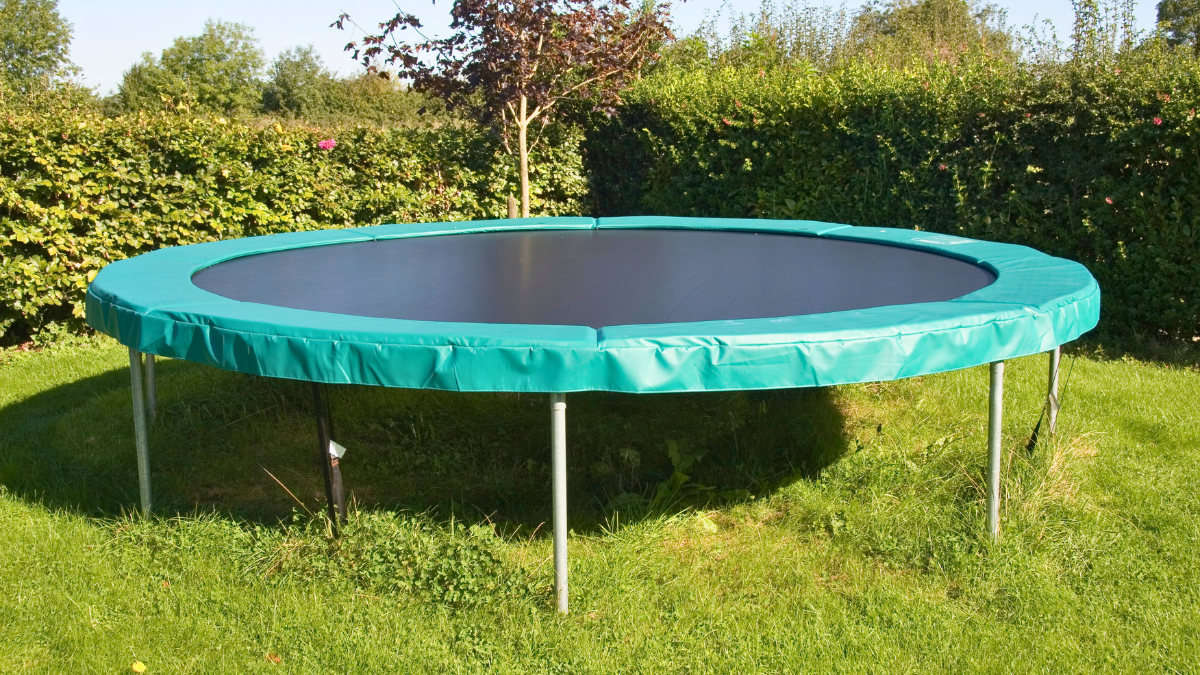
If you are asking, “A neighbour’s trampoline overlooks my garden – what can I do?”, you are certainly not alone.
There are few quicker ways to make a private garden feel exposed. One moment you are sitting outside with a cup of tea or moving around your kitchen; the next someone on a trampoline is bouncing high enough to see straight over the fence.
If your neighbour’s trampoline overlooks your garden, it is understandable to feel uncomfortable. The fact that the person looking over may be a child does not necessarily make the loss of privacy any less real, particularly if the trampoline is used for hours at a time or stands beside your patio, windows or seating area.
In my experience, these disputes are rarely about a single passing glance. The real problem is the feeling that part of your home or garden can no longer be used normally without being watched. Your neighbour, meanwhile, may see nothing more than children playing on an ordinary piece of garden equipment.
The legal answer is not especially satisfying: ordinary overlooking from a trampoline will not usually be unlawful by itself. There is no general rule requiring a domestic trampoline to be kept a particular distance from a boundary, and you cannot normally force a neighbour to move it simply because its users can see into your garden.
That does not mean anything goes. Deliberate spying, filming, abusive behaviour, persistent unreasonable noise or a wider campaign of intimidation may engage very different areas of law.
Neighbour trampoline rules at a glance
| Question | Short answer |
| Can my neighbour put a trampoline next to my fence? | Usually, yes. There is no general minimum distance from the boundary for an ordinary domestic trampoline. |
| Is overlooking from a trampoline illegal? | Usually not. Ordinary residential overlooking does not normally create a legal claim. |
| Does a trampoline need planning permission? | An ordinary movable garden trampoline will not usually require it, although permanent structures, raised platforms, extensive excavations or planning restrictions may alter the position. |
| Can I force my neighbour to move it? | Not merely because it overlooks your garden. Other legal issues would usually be needed. |
| Can I complain about the noise? | You can complain, but ordinary daytime noise from children playing is very unlikely to amount to a statutory nuisance. |
| Can the council intervene? | Not usually for overlooking alone. It may investigate persistent unreasonable noise, anti-social behaviour, harassment or a planning breach. |
| Can I build a higher fence? | Usually up to two metres without planning permission, or one metre beside a highway used by vehicles. Exceptions apply. |
Although those answers may initially seem disappointing, they don’t tell the whole story. In practice, many disputes can be resolved successfully without legal action, particularly where neighbours are willing to cooperate.
Contents of this guide
- Can my neighbour put a trampoline next to my fence?
- What can I do if a trampoline overlooks my garden?
- Does Article 8 protect me from trampoline overlooking?
- What did the Supreme Court decide in Fearn v Tate?
- When can trampoline use become anti-social behaviour?
- Can trampoline use amount to harassment?
- What about noise from a neighbour’s trampoline?
- Can I complain to the council?
- Can I make my fence higher?
- Can planting restore my privacy?
- Would an in-ground trampoline solve the problem?
- How should I raise the problem with my neighbour?
- What if my neighbour refuses to cooperate?
- Will the dispute need to be disclosed when I sell?
- Frequently asked questions
Can my neighbour put a trampoline next to my fence?
Usually, yes.
There is no general law in England and Wales requiring a garden trampoline to be positioned a fixed distance from a fence, wall or property boundary. A neighbour will therefore normally be free to place one wherever it fits within their garden.
An ordinary freestanding trampoline will not generally be treated in the same way as a permanent building. The position could be different where it forms part of a raised platform, involves substantial engineering works, is installed on land outside the lawful residential garden or is effectively permanent. Planning restrictions attached to the property may also matter. The title deeds, a lease or a tenancy agreement may contain additional restrictions. A restrictive covenant could, for example, prohibit structures or activities causing nuisance or annoyance, although whether it applies will depend upon its precise wording.
The absence of a minimum-distance rule does not mean that putting a trampoline directly beside a neighbour’s patio is necessarily considerate. It simply means that poor positioning is not automatically unlawful.
What can I do if a trampoline overlooks my garden?
Usually not.
English and Welsh law does not generally give homeowners a complete right to prevent neighbouring properties from overlooking them. Upstairs windows, balconies, sloping gardens, raised decking and ordinary garden activities may all create views into adjoining land.
A trampoline can make the overlooking more noticeable because the view repeatedly appears and disappears as somebody bounces. Nevertheless, an occasional view over the fence during ordinary play will be very unlikely to create a legal claim.
The distinction is between ordinary overlooking and something much more intrusive. A child briefly seeing into your garden is one thing. Somebody repeatedly using the trampoline to watch you, shout abuse, take photographs or peer deliberately through a window is quite another.
Does Article 8 protect me from trampoline overlooking?
Article 8 of the Human Rights Act 1998 protects the right to respect for private and family life, the home and correspondence.
That sounds as though it should provide a straightforward remedy. However, the Human Rights Act primarily regulates public authorities. It does not ordinarily allow one private homeowner to bring a standalone Article 8 claim against another simply because their garden is overlooked.
Convention rights can influence how courts interpret legislation and develop the common law, but Article 8 does not create a general right to complete visual privacy between neighbours.
What did the Supreme Court decide in Fearn v Tate?
The Supreme Court confirmed in Fearn v Board of Trustees of the Tate Gallery that intense visual intrusion can, in exceptional circumstances, amount to private nuisance.
The case concerned flats beside the Tate Modern in London. Visitors to a public viewing gallery could look directly into the residents’ glass-walled living areas. The gallery attracted very large numbers of visitors, some of whom waved, photographed the occupants and posted images online.
The Supreme Court decided that this went far beyond ordinary overlooking. Inviting members of the public to look into neighbouring homes was not a common and ordinary use of the Tate’s land, and the resulting intrusion was capable of amounting to nuisance. The decision did not establish a general legal right not to be overlooked. The Court distinguished the Tate viewing gallery from the ordinary give and take of residential life.
A normal family trampoline is therefore highly unlikely to come close to the facts of Fearn. A claim might become more arguable if the trampoline were being used deliberately and persistently as a platform for surveillance, but the evidence would need to show something significantly beyond ordinary play.
When can trampoline use become anti-social behaviour?
The trampoline itself is rarely the decisive issue. What matters is how it is being used.
Behaviour may become potentially actionable where somebody repeatedly uses the trampoline to:
- watch or follow your movements;
- shout abuse or make offensive gestures;
- photograph or film you;
- throw objects into your property;
- provoke you deliberately; or
- intimidate members of your household.
Under the Anti-social Behaviour, Crime and Policing Act 2014, an authorised person may issue a Community Protection Notice where conduct has a detrimental effect on the quality of life of people in the locality, is persistent or continuing, and is unreasonable. A written warning must ordinarily come first. That is a demanding test. A council is unlikely to use these powers because children occasionally glance over a fence while bouncing. Persistent, deliberately provocative behaviour may be different.
If the trampoline belongs to tenants, it may also be worth contacting their landlord or housing association. Tenancy agreements commonly contain clauses dealing with nuisance and anti-social conduct.
Can trampoline use amount to harassment?
Potentially, although an isolated incident or ordinary garden play will not be enough.
Under the Protection from Harassment Act 1997, harassment normally requires a course of conduct on at least two occasions. The person responsible must know, or ought to know, that the conduct amounts to harassment.
The behaviour must be sufficiently serious to go beyond the ordinary irritation, upset and friction that sometimes arise between neighbours. A trampoline might form part of harassment where it is deliberately used to monitor or intimidate you alongside threats, confrontations, abusive messages or other targeted conduct.
The police are unlikely to become involved in a simple disagreement about overlooking. They may become relevant where there are threats, stalking, violence, criminal damage or a sustained course of harassment.
If your concern involves deliberate recording rather than somebody merely looking over the fence, my guide to neighbour CCTV and privacy disputes explains the related privacy and surveillance rules.
What about noise from a neighbour’s trampoline?
The sound of a trampoline can become wearing. There may be repeated impacts from the mat, squeaking springs, shouting and prolonged use during the summer.
Councils must investigate complaints about noise that could amount to a statutory nuisance under the Environmental Protection Act 1990. To meet that test, the noise must unreasonably and substantially interfere with the use or enjoyment of a home, or injure health or be likely to injure health. tical difficulty is that ordinary noise from children playing during reasonable daytime hours is very unlikely to be treated as a statutory nuisance. Councils generally regard a certain amount of children’s play as part of normal residential life. tion may be different where the trampoline is used late at night, by adults behaving loudly, alongside amplified music or in a deliberately malicious way. The duration, timing, frequency and character of the noise will all matter.
My guide to dealing with noisy neighbours in the UK explains how councils investigate noise and when an abatement notice may be served.
Can I complain to the council?
You can complain, but it is important to direct the complaint to the right department and be realistic about the likely outcome.
A planning enforcement team is unlikely to act against an ordinary movable trampoline simply because it overlooks your property. It may investigate if the installation includes substantial permanent works, a raised platform, development on land that is not lawfully part of the garden or a breach of an existing planning condition.
Environmental Health may investigate excessive noise, although normal daytime play is unlikely to meet the statutory nuisance threshold.
The council’s anti-social behaviour team may become involved if the trampoline is being used as part of persistent, continuing and unreasonable conduct. It will need specific evidence of the behaviour rather than a general complaint that you feel overlooked.
When reporting the matter, explain exactly what is happening. “The trampoline overlooks my garden” is unlikely to lead anywhere. A chronological account of deliberate watching, repeated abuse, late-night use or filming gives the council something more concrete to assess.
Can I make my fence higher?
For many homeowners, additional screening is the most practical answer. Before altering a fence, however, check the planning rules.
In England, planning permission is normally required if a fence, wall or gate would exceed:
- one metre where it is beside a highway used by vehicles or the footpath of such a highway; or
- two metres elsewhere.
Restrictions also apply around listed buildings, and permitted development rights may have been removed by a planning condition or Article 4 direction. The Welsh rules also generally use limits of one metre beside a highway and two metres elsewhere, although the exact circumstances should be checked with the local planning authority. Attaching trellis to the top of a fence does not necessarily avoid the height restriction. The planning authority may measure the combined structure. Calling something “temporary” or “trellis” will not prevent it from being treated as part of the means of enclosure.
My guides to boundary fence rules and planning permission for a fence explain the height rules and common exceptions in more detail.
Before attaching anything to the existing fence, also check who owns it. Land Registry title plans rarely establish fence ownership conclusively, and the familiar belief that everyone owns the fence on a particular side of their garden is unreliable.
Can planting restore my privacy?
Planting can provide effective screening without creating the hard appearance of a very tall fence.
Evergreen shrubs and small trees may help, but choose them carefully and consider their eventual height, spread and root system. Yew, holly, Portuguese laurel and other suitable species can provide year-round screening when properly maintained.
Bamboo requires particular caution. Running varieties can spread rapidly through adjoining gardens and beneath paths or structures. My guide to dealing with a neighbour’s bamboo spreading into your garden explains the risks.
A hedge can also create a fresh dispute if it is allowed to become excessively tall. Councils have powers to consider complaints about certain hedges made up of two or more mainly evergreen or semi-evergreen trees or shrubs, over two metres high, where they adversely affect the reasonable enjoyment of a home or garden. The complainant must normally have tried to resolve the issue first. My broader guide to hedge law in the UK covers those rules.
Freestanding screens, pergolas and similar structures may also help, but they are not automatically exempt from planning control merely because they sit inside the boundary. Their height, position, design and permanence can all matter.
Would an in-ground trampoline solve the problem?
Sometimes.
An in-ground trampoline has its jumping mat close to lawn level, substantially reducing the height from which users can see into neighbouring gardens. It can be an effective compromise where the neighbour is willing to consider it.
Installing one involves more than digging a shallow hole. The excavation must deal safely with drainage, soil stability, underground services and access beneath the trampoline. Tree roots and nearby retaining structures may also be affected.
Substantial excavation or engineering works can raise planning questions in unusual cases, so the owner should check with the local planning authority if the proposal is extensive or the property is subject to restrictions.
How should I raise the problem with my neighbour?
Unless there has already been threatening or abusive behaviour, a calm conversation is usually the best place to begin.
Many trampoline owners simply do not realise what can be seen from the top of a bounce. From ground level, the fence may appear to provide complete privacy.
I would avoid beginning with legal threats. Explain the practical effect instead:
“When the trampoline is being used, it gives a direct view into our kitchen and patio. We’ve started feeling uncomfortable using that part of the garden. Would you consider moving or turning it?”
A request to move the trampoline a few metres, rotate it or agree reasonable times of use is more likely to succeed than demanding its complete removal.
It may help to invite your neighbour to stand at the relevant point in your garden so that they can see the line of sight for themselves. Equally, looking at the trampoline from their garden may reveal that a modest change would solve the problem.
If a calm conversation does not resolve the problem, my guide to dealing with neighbour disputes explains how to put the concern in writing, preserve useful evidence and consider mediation or other appropriate action.
What if my neighbour refuses to cooperate?
Keep your response proportionate.
Make a factual record of what happens, particularly if the conduct goes beyond ordinary play. Record dates, times, duration and precisely what was said or done. Photographs showing the position of the trampoline may be useful, but avoid unnecessary photography of children.
If the main issue is noise, keep a noise diary. If the conduct involves abuse, filming or deliberate intimidation, retain messages and write down incidents while they are fresh in your mind.
Mediation is often a better next step than a solicitor’s letter. An independent mediator can help both households agree practical measures such as repositioning, screening and hours of use. Government guidance describes mediation as confidential and generally quicker and cheaper than court proceedings. If behaviour becomes threatening, report it to the police. Persistent unreasonable anti-social behaviour can be reported to the council, landlord or housing association. Noise complaints should be directed to Environmental Health.
Court proceedings should normally be the last option. A private nuisance or harassment claim may be possible on exceptional facts, but ordinary trampoline overlooking is unlikely to justify the expense and risk.
My guide to property litigation costs explains why even a seemingly simple neighbour dispute can become expensive.
Will the dispute need to be disclosed when I sell?
Potentially, but not every awkward conversation automatically becomes a legally significant dispute.
The current Law Society Property Information Form asks sellers about past and present disputes and complaints involving neighbours or nearby properties. Formal correspondence, council complaints, mediation, threatened legal proceedings or a continuing disagreement may therefore need to be disclosed. The correct answer depends upon the questions in the form and the history of the problem. It is too broad to say that every casual request to move a trampoline must always be disclosed, or that a long-resolved issue can automatically be ignored.
A seller should answer the conveyancing enquiries accurately and discuss any uncertainty with their conveyancer. Concealing a material dispute can expose the seller to a later misrepresentation claim.
My guide to property misrepresentation claims explains the potential consequences of inaccurate replies.
Frequently asked questions
Can I stop my neighbour putting a trampoline next to my fence?
Usually not.
There is no general rule requiring an ordinary garden trampoline to be a minimum distance from a boundary. Planning restrictions, restrictive covenants, lease terms or tenancy conditions may occasionally affect the position.
Does a garden trampoline need planning permission?
An ordinary movable trampoline used as part of a domestic garden will not usually need planning permission.
A permanent raised structure, extensive excavation, installation outside the lawful garden or breach of an existing planning restriction may require closer examination.
Can I force my neighbour to move the trampoline?
Not simply because it overlooks your garden.
You would normally need to establish some additional legal basis, such as harassment, serious private nuisance, a planning breach or an enforceable covenant. In most cases, negotiation or mediation is more realistic.
Is it illegal for children to look into my garden while bouncing?
No. An occasional view into your garden during ordinary play will not normally be unlawful.
Deliberate and repeated watching, abusive behaviour, photography or intimidation may alter the position.
Can I complain about trampoline noise?
Yes, but ordinary daytime noise from children playing is very unlikely to be treated as a statutory nuisance.
Persistent late-night use, amplified music, mechanical noise or deliberately excessive disturbance may give the council more reason to investigate.
Can I put trellis on top of my two-metre fence?
You should not assume that trellis is excluded from the height calculation.
Where trellis is attached to a fence, the local planning authority may measure the total height of the combined structure. Planning permission may therefore be required.
Can I plant a hedge higher than two metres?
There is no automatic prohibition on a hedge exceeding two metres.
However, certain mainly evergreen or semi-evergreen hedges made up of two or more trees or shrubs can become the subject of a council complaint if their height adversely affects the reasonable enjoyment of a neighbouring home or garden.
Can I sue my neighbour for loss of privacy?
Ordinary residential overlooking will not normally support a claim.
The Supreme Court has accepted that exceptionally intense visual intrusion can amount to private nuisance, but a domestic trampoline used in an ordinary way is far removed from the circumstances of Fearn v Tate.
What if my neighbour photographs me from the trampoline?
Deliberate photography may raise issues beyond ordinary overlooking, particularly if it is repeated, intrusive, threatening or the images are shared publicly.
Depending upon the circumstances, privacy law, harassment, data protection or criminal law may become relevant. Keep a clear record and seek advice if the conduct continues.
Restoring privacy without creating a bigger dispute
Feeling overlooked in your own home or garden can be genuinely upsetting. The law’s limited protection against ordinary overlooking does not make that discomfort imaginary or unreasonable.
At the same time, most trampoline owners are not trying to invade anybody’s privacy. They have simply placed a large piece of equipment where it fits, without appreciating the view created at the top of each bounce.
A small move, a change of direction, sensible hours of use or carefully designed screening will often achieve more than a formal complaint. Where the conduct becomes deliberate, persistent or intimidating, however, the law may provide stronger options.
The key is to focus on what is actually happening. An ordinary family activity calls for practical compromise. A sustained campaign of surveillance or harassment calls for evidence and a more formal response.
Last legally reviewed on 26 July 2026
This article is based on general principles of English and Welsh law, is intended for informational purposes only, and does not constitute legal advice or establish a professional relationship.







One response to “Neighbour’s trampoline overlooks my garden: What can I do?”
[…] If the problem is ordinary overlooking rather than recording, the position can be different. See my guides to a neighbour’s balcony or roof terrace overlooking your garden and a neighbour’s trampoline overlooking your garden. […]