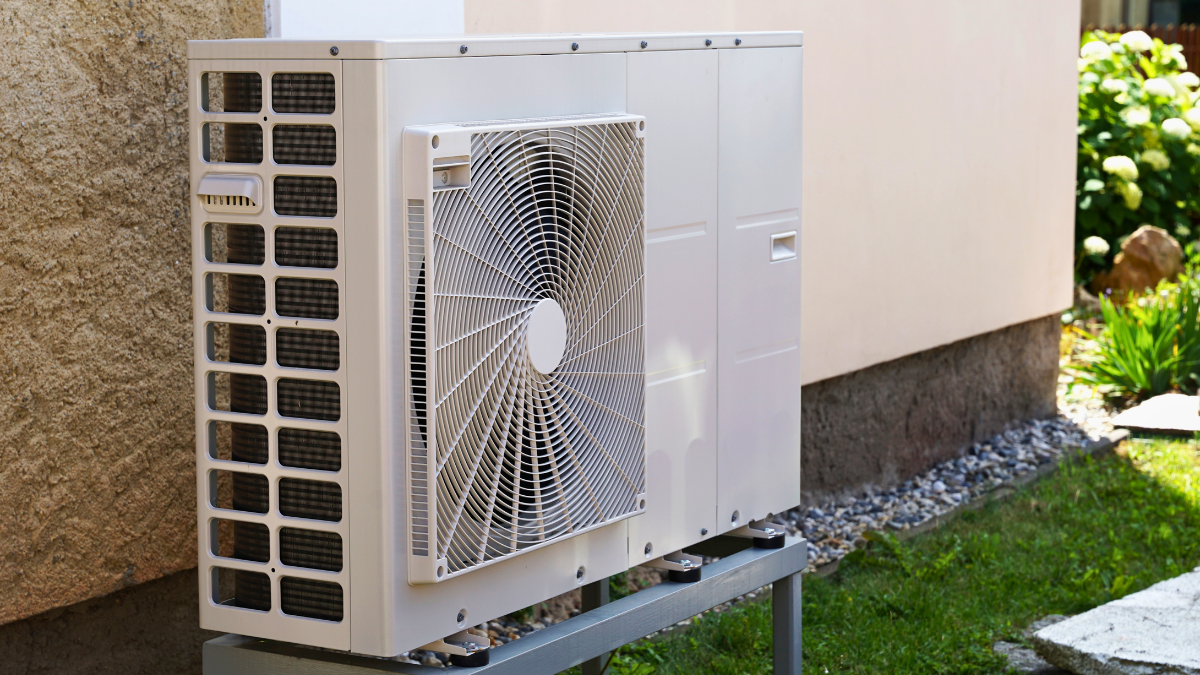
Air source heat pumps are becoming a familiar sight outside homes across England and Wales. Most operate without troubling anybody. When a unit is badly positioned, poorly mounted or unusually close to a neighbour’s bedroom, however, its steady mechanical hum can become difficult to ignore.
Noise of this kind is particularly frustrating because it may seem quite modest during the day, only to become much more noticeable late at night when everything else is quiet. Once you have tuned into a repetitive hum, it can be remarkably hard to tune it out again.
I have seen over the years how quickly an apparently minor problem between neighbours can become entrenched. One household regards the heat pump as an essential and expensive part of its heating system; the other feels unable to sleep or enjoy its home. Both may genuinely believe that the law is clearly on their side.
Unfortunately, the rules are not quite that simple. Planning law, the MCS noise calculation and the law of statutory nuisance all play different roles. To complicate matters further, the widely quoted 42 dB limit has now been replaced by a 37 dB limit for current permitted-development assessments in England and Wales.
Air source heat pump noise rules at a glance
| Issue | Position |
| Is planning permission always required? | No. Many domestic installations are permitted development if all the relevant conditions are satisfied. |
| What is the current MCS noise limit? | The MCS 020(a) calculation must produce no more than 37 dB(A) at every relevant assessment position. |
| Why do people still mention 42 dB? | It was the limit under the previous MCS 020 calculation and remains relevant when considering some older installations. |
| Must a heat pump be a set distance from the boundary? | England no longer has the former one-metre rule, and Wales removed its three-metre rule on 1 June 2026. Other planning and noise conditions still apply. |
| Can neighbours complain about a compliant installation? | Yes. Planning compliance does not prevent a statutory nuisance investigation. |
| Can a council require alterations? | Yes, where it is satisfied that a statutory nuisance exists or is likely to occur. |
Contents of this guide
- What is the current heat pump noise limit?
- What happened to the 42 dB heat pump limit?
- How does the MCS 020(a) noise calculation work?
- Does a heat pump have to be a certain distance from the boundary?
- When is planning permission required for an air source heat pump in England?
- Can you object to a neighbour’s air source heat pump?
- Can a compliant heat pump still be a statutory nuisance?
- What happens when Environmental Health investigates?
- What should you do if a neighbour’s heat pump is disturbing you?
- How can heat pump owners reduce the risk of complaints?
- Frequently asked questions
What is the current heat pump noise limit?
For a new installation relying on permitted development rights, the important standard is now MCS 020(a) issue 1.1.
It contains a calculation intended to establish whether the noise from a proposed air source heat pump will be no more than 37 dB LAeq,5mins at the assessment positions, ignoring the effect of the façade.
Put more simply, the installer uses technical information about the proposed unit and its surroundings to predict the sound reaching relevant doors and windows at neighbouring properties. The calculated result must be 37 dB(A) or lower at every assessment position.
Meeting that requirement does not, by itself, make an installation permitted development. All the other planning limitations and conditions must also be satisfied.
In England, MCS 020(a) became the only permitted certification method on 28 May 2026. The Planning Portal’s current heat pump guidance sets out the remaining English conditions.
In Wales, revised permitted development rights took effect on 1 June 2026 and also refer to MCS 020(a). The Welsh Government’s domestic heat pump guidance should be checked because the detailed planning rules are not identical in England and Wales.
What happened to the 42 dB heat pump limit?
The 42 dB figure has not been plucked from thin air. It was the permitted development noise limit used by the previous MCS 020 standard, which covered air source heat pumps and small wind turbines.
That explains why so many planning decisions, installers’ calculations and online articles still refer to a heat pump noise limit of 42 dB(A). It may also remain relevant when looking at whether an older installation complied with the rules that applied when it was installed.
The new 37 dB figure should not simply be described as the old limit minus five decibels. MCS 020(a) introduced a revised calculation method, including different treatment of assessment positions, reflecting surfaces and barriers. The two figures therefore belong to different versions of the assessment.
The original MCS 020(a) issue 1.0 document, which replaced the previous MCS 020 standard, explains the revised approach.
Anyone considering a new installation should make sure that the installer is using the current standard rather than an older 42 dB worksheet.
How does the MCS 020(a) noise calculation work?
The MCS assessment is not normally a sound-meter reading taken after the heat pump has been installed. It is a predictive calculation carried out before installation.
The starting point is the manufacturer’s published sound power level for the proposed heat pump. Sound power is not the same as a sound pressure reading taken at a particular distance from the unit, so figures on sales literature must be treated carefully.
MCS 020(a) also says that the figure for a special “low noise mode” must not be used in the calculation.
The installer then considers matters including the distance from the unit to neighbouring properties, nearby walls and other reflective surfaces, solid barriers and whether there is a clear line of sight between the unit and the assessment position.
An assessment position is located one metre outside the centre of a door or window to a habitable room at a neighbouring property. A habitable room generally means a room used for living or sleeping. It does not include bathrooms, toilets, corridors, hallways, laundry rooms or utility rooms.
This is not always simply the nearest bedroom window. Several positions may need to be assessed, including doors and windows on different floors and at properties on more than one side of the installation.
A slightly more distant window with an unobstructed line of sight may receive more calculated noise than a closer window shielded by a solid wall.
The installer should retain a completed copy of the calculation and provide another to the customer. That document may later become important if a neighbour, council or future purchaser raises questions about the installation.
Does a heat pump have to be a certain distance from the boundary?
Not necessarily.
England formerly required an air source heat pump to be at least one metre from the property boundary to qualify as permitted development. That blanket requirement was removed on 29 May 2025.
Wales retained a stricter three-metre boundary rule for longer, but that rule was removed when the revised Welsh regulations came into force on 1 June 2026.
Removing these fixed distances does not mean that a unit can be placed anywhere. The proposed position still has to pass the MCS 020(a) sound calculation, and all other planning conditions must be met.
A unit close to the boundary may pass where the neighbouring house is some distance away or is protected by a suitable barrier. Conversely, a unit some distance from the boundary may fail if it points towards an exposed bedroom window.
It is also worth checking precisely where the legal boundary lies. Fences, hedges and old walls are not always reliable evidence of ownership. My guide to property boundaries in England and Wales explains how plans, deeds and physical features should be approached.
When is planning permission required for an air source heat pump in England?
Many domestic air source heat pumps in England are permitted development, but only if every applicable limitation and condition is satisfied.
Among the current requirements, the installation must comply with MCS 020(a). The outdoor compressor unit, including its housing, must not exceed 1.5 cubic metres at a house or 0.6 cubic metres at a block of flats.
At a detached house, the first two air source heat pumps may qualify as permitted development. At a non-detached house or block of flats, only the first installation qualifies.
For a leaseholder, however, permitted development does not answer what the lease allows. Fixing a unit to an external wall, roof or balcony, or drilling through the building for pipes and cables, may still require the freeholder’s consent. My guide to freeholder consent for air conditioning in a leasehold flat explains these separate leasehold issues, including where a system provides both heating and cooling.
Special rules apply to roofs, highway-facing locations, conservation areas, World Heritage Sites, listed buildings and scheduled monuments.
Permitted development rights may also have been removed by a planning condition or an Article 4 direction. Where there is genuine doubt, the safest course is to check with the local planning authority or consider applying for a lawful development certificate.
The government’s older technical guidance on householder permitted development rights remains useful for understanding the general structure of permitted development, although it predates the recent heat pump changes.
Can you object to a neighbour’s air source heat pump?
You can object if your neighbour submits a planning application. The local planning authority may consider matters including noise, siting and the effect on neighbouring amenity.
If the proposed installation is genuinely permitted development, there is usually no planning application and therefore no ordinary consultation process.
That can feel deeply unfair when a unit appears beside your garden or close to a bedroom, but permitted development amounts to a national grant of planning permission where all the conditions are met.
You can still ask the planning authority to investigate if you believe the development does not satisfy those conditions. For example, the MCS calculation may be missing, the unit may be too large or a planning restriction may apply to the property.
Merely being able to hear the heat pump will not establish a breach. The law does not promise complete silence between neighbouring homes.
The more important questions are whether the installation complies with the planning rules and whether the noise it produces in practice is unreasonable enough to amount to a statutory nuisance.
My broader guide to dealing with noisy neighbours in the UK explains the usual complaint process.
Can a compliant heat pump still be a statutory nuisance?
Yes. This is one of the most important parts of the law to understand.
The MCS calculation belongs to the planning regime. It helps decide whether an installation can rely on permitted development rights. It does not provide permanent immunity from complaints, nor does it guarantee that the completed heat pump will never cause an unreasonable disturbance.
Noise from premises is capable of amounting to a statutory nuisance under the Environmental Protection Act 1990.
Part III of the Act gives local authorities duties and powers to investigate.
There is no universal decibel reading at which a domestic heat pump automatically becomes a statutory nuisance. The question is whether the noise unreasonably and substantially interferes with the use or enjoyment of a home or other premises, or injures health or is likely to injure health.
Environmental Health may consider its volume, duration, frequency, timing and character, together with the nature of the surrounding area and its effect on everyday life.
A steady tonal or low-frequency sound during a quiet winter night may be assessed differently from an occasional noise during a busy afternoon.
That does not mean that every irritating hum is unlawful. Statutory nuisance is a fairly demanding legal test. Each case turns on its own facts.
What happens when Environmental Health investigates?
A council will commonly begin by asking the complainant for details of the noise and its effect.
You may be asked to keep a diary recording when the pump operates, how long the disturbance continues, where it can be heard and whether it affects sleep or ordinary activities.
Officers may contact the heat pump owner, visit the complainant’s home or arrange for noise-monitoring equipment to be installed.
Their assessment is not necessarily determined by a single decibel reading. Professional judgement and the overall pattern of the disturbance are important.
If the council is satisfied that a statutory nuisance exists, has occurred or is likely to occur, it must serve an abatement notice.
That notice can require the person responsible to stop or restrict the noise or to take specified remedial steps.
The notice does not automatically mean that the heat pump must be removed. Depending on the cause, the problem might be addressed by moving the unit, improving vibration isolation, changing its mounting, repairing a fault or installing properly designed acoustic protection.
Failure to comply with an abatement notice can lead to prosecution and fines. The council may also carry out works and seek to recover its costs in an appropriate case.
What should you do if a neighbour’s heat pump is disturbing you?
Unless there is a good reason not to approach the owner, a calm conversation is usually the best starting point.
Many people cannot hear their own outdoor unit in the same way that a neighbour can hear it from an upstairs bedroom. They may genuinely have no idea that there is a problem.
I would keep that first conversation factual rather than threatening. Explain where and when the sound is most noticeable and ask whether the installer can return to investigate.
A loose panel, poor mounting or vibration against masonry may be easier to correct than either household expects.
For wider guidance on approaching the neighbour, keeping an effective record, involving the council and escalating the complaint proportionately, see my guide to resolving neighbour disputes.
If the noise continues, keep a careful diary. Record the date and time, how long the noise continued, the weather conditions, where it was audible and how it affected you.
A series of precise entries such as “continuous hum audible in rear bedroom from 11.20 pm until 2.10 am; prevented sleep even with window closed” is much more useful than repeatedly recording that the pump was “very noisy”.
You can also ask, politely, for a copy of the MCS 020 or MCS 020(a) calculation. Its date will help identify which standard was used.
Check that it describes the actual model and location and includes all potentially affected assessment positions.
Where informal efforts fail, report the problem to Environmental Health. The government provides a service for finding the correct council through its noise complaint page.
Private legal proceedings should normally be considered only after the practical and council routes have been explored. Litigation can be expensive, stressful and unpredictable.
My guide to property litigation costs explains some of the financial risks.
How can heat pump owners reduce the risk of complaints?
The cheapest moment to solve a noise problem is before the heat pump is installed.
Do not choose a position merely because it is convenient for the pipework. Consider neighbouring bedrooms and living rooms, the direction the fan faces, hard surfaces that may reflect sound and structures through which vibration may travel.
A heat pump placed between two brick walls may sound noticeably different from the same model in an open position. Fixing it directly to masonry can also transmit vibration into a building, even where its airborne noise does not seem particularly high.
Ask to see the completed MCS 020(a) calculation before installation and check that the installer has used the correct sound power figure rather than an attractive sound pressure figure taken from marketing literature.
The standard does not allow the calculation to rely upon a special low-noise operating mode.
After installation, rattling, tonal changes or an increase in noise should be investigated rather than dismissed as inevitable. Regular maintenance, a stable base and suitable anti-vibration mounts can all matter.
Acoustic screens and enclosures require care. A barrier may reduce sound in a particular direction, but a poorly designed enclosure can restrict airflow, reduce efficiency or conflict with the manufacturer’s requirements.
Installing a heat pump does not ordinarily engage the Party Wall etc. Act 1996 by itself. Associated foundations, excavations or works to a shared structure could do so, however.
My guide to the Party Wall Act explains when notices may be required.
Frequently asked questions
Is the heat pump noise limit 37 dB or 42 dB?
For a current permitted development assessment under MCS 020(a), the limit is 37 dB(A) at every relevant assessment position.
The 42 dB(A) figure belonged to the previous MCS 020 calculation and may still appear in older documents, planning records and online guidance.
Is 37 dB loud?
A bare comparison with familiar sounds is not especially helpful. The figure is a calculated sound level at a defined position, not necessarily a sound-meter reading taken beside the outdoor unit.
How noticeable a heat pump seems in practice will depend on background noise, tonal character, vibration, timing, location and the person’s position in relation to it.
A repetitive sound may become intrusive even though it does not appear especially loud in isolation.
Can I use a phone app to prove that a heat pump is too noisy?
A phone app may help you identify patterns or compare conditions, but it is unlikely to provide definitive legal or technical proof.
Phones are not calibrated professional sound meters, and the MCS assessment requires a calculation using defined data and positions.
Phone recordings may nevertheless help demonstrate the character and timing of a problem when supplied alongside a detailed diary.
Can the council make my neighbour move the heat pump?
Potentially.
If the council finds a statutory nuisance, an abatement notice can require whatever reasonable steps are necessary to stop or restrict it.
Depending on the circumstances, that could include repairs, acoustic treatment, altered operation or relocation.
Removal or relocation is not automatic. A less drastic remedy may be sufficient.
Does an MCS certificate prevent a noise complaint?
No.
MCS documentation may be strong evidence that the installation was assessed against the relevant planning standard, but planning compliance and statutory nuisance are separate questions.
The council can still investigate the noise actually produced by the completed installation.
Must a heat pump dispute be disclosed when selling a home?
Sellers completing conveyancing forms are asked about disputes and complaints affecting the property. Answers must be accurate and should not conceal a formal or continuing problem.
A single polite conversation does not automatically become a legal dispute. Formal council complaints, legal correspondence or an unresolved pattern of allegations are more likely to require disclosure, depending on the questions asked and the circumstances.
My guide to property misrepresentation claims explains what can happen when information given during a sale is inaccurate or incomplete.
Why careful positioning still matters
The move from fixed boundary distances towards a noise-based assessment gives homeowners more freedom, particularly where space is limited.
It also places greater responsibility on installers to assess each site properly rather than treating the outdoor unit as an appliance that can simply be placed in the nearest available corner.
Most air source heat pumps do not result in neighbour disputes. Where problems occur, the cause is often not the technology alone but a combination of siting, reflected sound, vibration, poor maintenance and a failure to discuss the issue early.
For owners, the best protection is a careful design, a current MCS 020(a) calculation and a willingness to investigate genuine concerns.
For neighbours, accurate records and a measured approach are usually more productive than assuming that hearing the unit necessarily makes it unlawful.
Last legally reviewed on 26 August 2026
This article is based on general principles of English and Welsh law, is intended for informational purposes only, and does not constitute legal advice or establish a professional relationship.







One response to “Air source heat pump noise rules: 37 dB and 42 dB limits explained”
[…] air source heat pump noise. […]