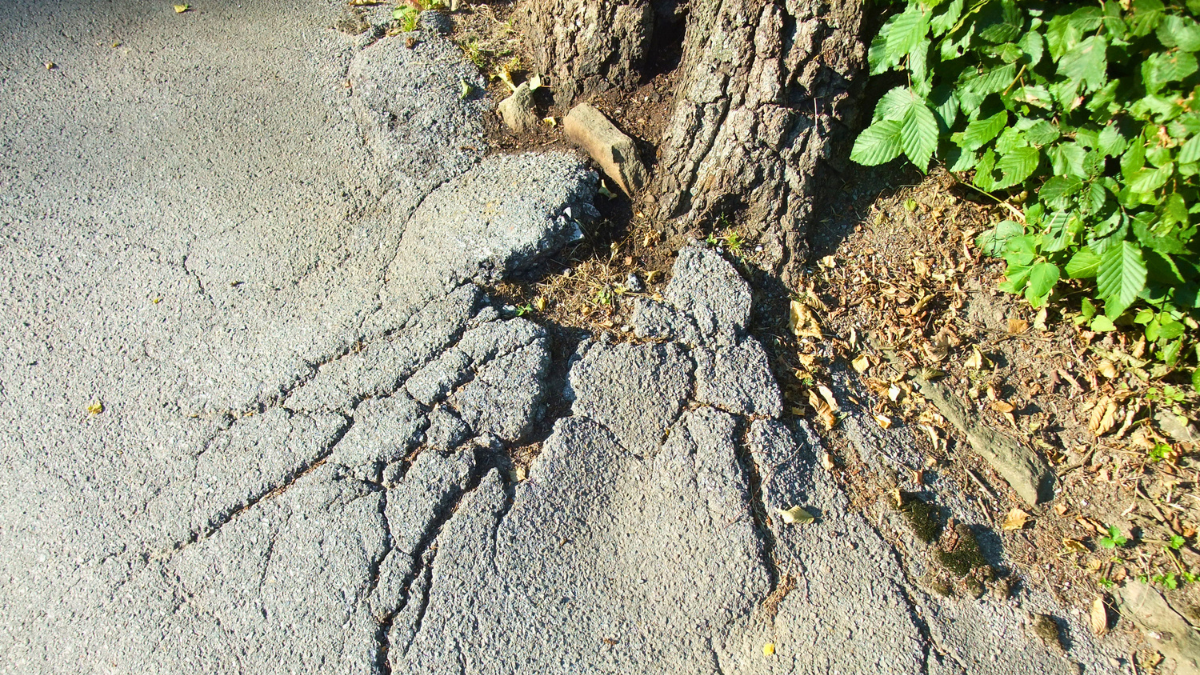
A tree can stand comfortably in one garden while causing most of its practical problems in another.
Branches may overhang a roof or scrape against windows. Roots may lift paving, enter a damaged drain or be blamed for cracks in a house. A tree that once provided welcome privacy may become a source of anxiety after a storm or when decay appears in a large limb.
Tree root and branch liability UK law does not make the tree owner automatically responsible for every inconvenience or item of damage. Nor does it leave the affected neighbour powerless.
A neighbour may usually cut roots and branches that cross the legal boundary back to that boundary. The work must be carried out from their own land, with reasonable care and subject to planning and wildlife protections.
The tree owner may be liable where the tree causes foreseeable damage or presents an apparent danger and they fail to respond as a reasonable and prudent landowner would. That normally requires more than proving that the tree exists, is large or stands close to the boundary.
During my years in legal practice, I found that tree disputes often went wrong at the point when one side treated a general rule as an absolute one. “It is my tree, so you cannot touch it” is not the law. Neither is “It crosses my boundary, so I can cut whatever I like.”
This guide explains the position in England and Wales, including overhanging branches, encroaching roots, dangerous trees, protected trees, subsidence and compensation.
Quick answer: Who is responsible for tree roots and branches?
The person who owns or controls the land on which the tree grows is generally responsible for managing it as a reasonable and prudent landowner.
That does not make them automatically liable when a branch falls or roots are discovered next door. Liability usually depends on whether:
- the tree caused the relevant damage or injury;
- the risk was reasonably foreseeable;
- the owner knew or ought reasonably to have known about it; and
- they failed to take reasonable and proportionate action.
A neighbour can ordinarily cut overhanging branches and encroaching roots back to the legal boundary without first obtaining the tree owner’s permission. They must not cross the boundary or carry out work carelessly, and they must check whether the tree is legally protected. (GOV.UK)
Who owns the tree?
A tree whose trunk stands wholly within one property will ordinarily belong to the owner of that land.
The branches may spread across several gardens and roots may extend much further underground, but that does not transfer ownership of the tree.
Where the trunk stands on or across the legal boundary, the position is less straightforward. The neighbours may have shared rights in the tree, or the precise ownership may depend on the location of the boundary and the trunk at ground level.
Do not assume that a fence proves ownership. Fences are often erected away from the legal boundary to avoid trees, banks and other obstacles. GOV.UK confirms that there is usually no official record identifying precisely who owns a tree growing between two properties.
Where a mature trunk appears to straddle the line, check the deeds and boundary evidence before removing or substantially pruning it. My guide to property boundaries in England and Wales explains that investigation in more detail.
Can you cut overhanging branches?
Yes, generally.
A landowner or occupier has a long-established common-law right to cut branches that project into their property. The work can be carried out without the tree owner’s agreement, but only from the point at which the branch crosses the legal boundary.
The neighbour cannot:
- cut back beyond the boundary;
- enter the tree owner’s garden without permission;
- reach across the boundary to make a more convenient cut;
- climb the trunk from the neighbour’s side;
- rest a ladder or other equipment against the tree without permission; or
- use the work as an excuse to reshape the whole tree.
GOV.UK describes the right as one to trim branches or roots crossing into the property, but only as far as the property boundary.
The right exists even where the overhang has not caused physical damage. That does not mean the tree owner must undertake the work or reimburse the neighbour’s pruning costs.
Do you have to warn the tree owner first?
There is no general requirement to obtain consent before cutting an unprotected tree back to the boundary from your own land.
Giving reasonable advance warning is nevertheless sensible.
The tree owner may point out that it is protected, arrange a better arboricultural cut from their side or agree to deal with more of the crown at the same time. Notice also reduces the risk of the owner returning home to find a tree surgeon working unexpectedly above the fence.
Communication does not alter the legal boundary. The neighbour remains entitled to refuse access to their land or to object to any cut beyond the line.
How far can you cut the branch back?
Only to the legal boundary.
That does not always produce the best pruning point. A branch cut exactly where it crosses the line may be left with an unhealthy stub, while the technically correct pruning point may lie closer to the trunk on the tree owner’s land.
The neighbour cannot cross the boundary to reach that point without permission. The better solution is often to agree that a qualified tree professional may make the correct cut from the owner’s side.
Where agreement is impossible, the neighbour must remain within the extent of the self-help right.
Can cutting back an overhang make you liable?
Yes.
The common-law right does not provide immunity for careless or excessive work.
If pruning foreseeably makes the tree unstable, kills it or causes avoidable structural damage, the person carrying out or commissioning the work may face a claim. Councils commonly warn that excessive cutting capable of causing tree failure can result in liability.
Risk is particularly high where the proposed work involves:
- a large structural limb;
- a substantial proportion of the crown;
- an old or veteran tree;
- an already leaning or unbalanced tree;
- decay or cavities;
- previous severe pruning; or
- roots important to the tree’s stability.
A competent arboricultural contractor should assess the whole tree rather than treating the boundary as the only relevant consideration.
Can you cut roots growing into your land?
The same broad self-help right applies to roots crossing the boundary.
They may ordinarily be cut where they enter your land, subject to protected-tree controls and the need to exercise reasonable care. GOV.UK expressly includes encroaching roots within the boundary-cutting rule.
Root cutting is often considerably more dangerous than removing small branches.
A major root may be providing structural support. Severing it can cause instability, decline or death. Cutting several roots may change the moisture balance in clay soil or remove evidence needed in a subsidence investigation.
Do not begin by digging along the boundary with a saw. Obtain advice from an arboricultural consultant where the roots are substantial, close to the trunk or associated with structural damage.
Can you cut the roots even if this kills the tree?
That should not be treated as a safe consequence of exercising the boundary right.
A neighbour is entitled to protect and use their land, but must act reasonably. Deliberately or carelessly cutting roots in a manner likely to kill or destabilise the tree may expose them to a damages claim and, where the tree is protected, criminal enforcement.
The practical legal right and the arboricultural safety of exercising it are separate questions. The fact that a root crosses the boundary does not prove that severing it is a responsible solution.
Who owns the cut branches and roots?
Cut material remains the property of the tree owner.
The neighbour should offer the branches, roots and attached fruit back. The owner does not have to accept them. Where they decline, the person who cut them should arrange lawful disposal.
Do not throw branches or garden waste over the fence. Offering the cuttings is not the same as depositing them on somebody else’s land without permission. Local-authority guidance expressly warns against throwing rejected cuttings back across the boundary.
For a substantial job, agree disposal arrangements before the contractor arrives.
Can you pick fruit from an overhanging branch?
Fruit still attached to the neighbour’s tree belongs to the tree owner.
An overhanging branch does not ordinarily entitle the adjoining occupier to harvest the fruit while leaving the branch in place. If the branch is lawfully cut back, fruit attached to the cut section forms part of the material that should be offered to the owner.
It is better to ask. A conversation about a few apples is usually preferable to developing a test case in the law of fruit and boundaries.
Must the owner prevent every overhang?
No.
The mere fact that branches cross the boundary does not ordinarily require the owner to prune them. The affected neighbour has the self-help right to cut the encroaching parts.
A stronger obligation may arise where the branches:
- present an apparent danger;
- cause or threaten actionable physical damage;
- seriously obstruct a private right;
- obstruct a public highway; or
- form part of a qualifying high hedge subject to council action.
A dislike of shade, falling leaves or the tree’s appearance will not usually be enough to compel work.
What duty does a tree owner owe?
A tree owner must act as a reasonable and prudent landowner.
That is not a guarantee that no branch will ever fall. Trees are living organisms, and even a healthy-looking tree can fail without negligence by its owner.
In Stagecoach South Western Trains Ltd v Hind [2014] EWHC 1891 (TCC), a large stem fell from an apparently healthy tree onto a railway. The court held that an ordinary homeowner was not required to employ an arboricultural expert to inspect trees periodically where there was no trigger or warning sign.
The judgment summarised the position broadly as follows:
- the owner is not an insurer of nature;
- a reasonable landowner should make periodic informal observations;
- action is required where danger is apparent;
- expert advice may be needed where an observation reveals a potential problem or the owner lacks the knowledge needed to assess it; and
- the circumstances, use of neighbouring land and resources of the owner may affect what is reasonable.
How often must a homeowner inspect a tree?
There is no statutory domestic inspection timetable.
An ordinary homeowner is not automatically required to commission an annual arboricultural report for every garden tree. What is reasonable depends on the tree, its location and any warning signs.
A homeowner should notice obvious matters such as:
- substantial dead limbs;
- recent cracking or splitting;
- fruiting bodies suggesting decay;
- sudden or increasing lean;
- lifted ground or damaged roots;
- storm damage;
- large hanging branches; and
- a history of previous branch failure.
Where such a feature appears—or where a very large tree stands beside a busy road, school, railway or frequently used area—professional advice may be required.
A commercial landowner, council or organisation managing many trees may need a more structured inspection system than a private householder with one apparently healthy garden tree.
Who is liable when a branch falls?
Liability is not automatic.
The claimant must normally establish that the owner failed to act as a reasonable and prudent landowner and that this failure caused the branch to fall and produce the loss.
A claim may succeed where decay or instability was obvious, previous failures had occurred or an expert recommendation was ignored.
It may fail where the tree appeared healthy and the relevant defect was hidden and would not reasonably have been discovered. Stagecoach v Hind applied that distinction and rejected liability where nothing visible should have alerted the homeowner to the internal defect.
What if the tree falls during a storm?
A storm does not automatically make the owner liable, and describing the event as an “act of God” does not automatically provide a defence.
The real questions remain:
- Was the tree defective or dangerous beforehand?
- Was that condition apparent or reasonably discoverable?
- Had the owner received warnings?
- Would reasonable work have prevented the failure?
- Was the weather so exceptional that a sound tree might have failed anyway?
Where a healthy tree fails unexpectedly in extreme weather, the loss will commonly be dealt with under the affected property’s insurance.
Where the owner ignored visible decay or a professional recommendation, bad weather may be the final event without relieving them of responsibility.
What if a dangerous branch hangs over my property?
Raise the concern in writing and provide clear photographs.
Explain what appears unsafe, where it could fall and whether there has been previous movement or branch failure. Avoid asserting that the whole tree is dangerous unless there is evidence supporting that conclusion.
Where there appears to be an immediate risk to people, keep away from the affected area and contact the tree owner, emergency services or relevant authority as appropriate.
A qualified arboriculturalist can assess whether the branch requires removal, reduction, support or monitoring.
If the danger remains and voluntary action is refused, legal remedies may include an injunction. Urgent court proceedings require proper expert evidence and involve costs risk.
What if a tree obstructs a public road or pavement?
The public-highway position is separate from an ordinary private overhang.
A highway authority has powers to require trees, hedges or shrubs to be cut where they overhang a highway so as to endanger or obstruct users or interfere with visibility.
Report the problem to the authority responsible for the road or footway. A private neighbour should not enter highway land or interfere with a council-owned tree merely because it overhangs their boundary.
You can identify the relevant authority through GOV.UK’s local council service.
Tree roots and direct physical damage
Roots can cause direct damage by displacing relatively lightweight structures and surfaces.
Examples include:
- paving and patios;
- driveways;
- shallow garden walls;
- small outbuildings; and
- kerbs or drainage channels.
The presence of roots does not prove legal liability. The claimant must establish which tree the roots came from, what damage they caused and why the owner should reasonably have foreseen or prevented it.
A wall may also have inadequate foundations or pre-existing deterioration. Paving may have been laid too close to a mature tree without allowance for predictable growth.
The correct remedy may involve flexible surfacing, local reconstruction, root management or redesign rather than felling the tree.
Roots in drains
Tree roots are attracted to water and nutrients.
They commonly enter drains through failed joints, cracks or other defects and then grow within the pipe. Their presence does not necessarily prove that the tree broke into a previously sound drain.
A CCTV survey may be required to determine:
- where the roots entered;
- whether the pipe was already defective;
- whether the roots enlarged the defect;
- which tree is the likely source; and
- whether repair, lining or replacement will prevent recurrence.
Local-authority tree policies commonly recognise that roots usually exploit existing drain defects rather than penetrating intact modern pipes.
Roots and subsidence
More substantial tree-root claims often involve shrinkable clay soil.
Roots extract moisture from the ground. In dry conditions, susceptible clay may shrink unevenly beneath shallow foundations and cause downward movement.
The tree roots do not have to push physically against the foundations. The alleged mechanism is moisture extraction and ground shrinkage.
Liability is not automatic simply because a tree is nearby or roots are found in a trial pit. The claimant normally needs structural, arboricultural and geotechnical evidence addressing:
- the soil;
- foundation depth;
- crack pattern;
- seasonal movement;
- root identity;
- drains and competing causes; and
- whether the tree made a material contribution.
My detailed guide explains compensation for tree root damage, including insurance, council trees and the evidence required.
Must the tree owner be notified about root damage?
Formal notice is not invariably a legal prerequisite, but it is often important.
A tree owner cannot respond to a hidden subsidence problem they have no reason to suspect. Sending credible expert evidence establishes what they were told and gives them an opportunity to inspect, contact their insurer and consider proportionate work.
The House of Lords’ decision in Delaware Mansions Ltd v Westminster City Council [2001] UKHL 55 concerned a continuing tree-root nuisance. The council became responsible for reasonable remedial expenditure after it knew or ought to have known of the problem and failed to abate it.
Notice should be factual and accompanied by the relevant report rather than an unsupported demand that the tree be felled immediately.
Can the neighbour force the tree to be removed?
Potentially, but only in a suitable case.
Where an actionable and continuing nuisance or serious safety risk is proved, a court may grant an injunction requiring appropriate action.
That action does not necessarily mean felling. Depending on the evidence, the effective and proportionate solution may be:
- selective pruning;
- monitoring;
- root management;
- repairing a drain;
- installing a root barrier;
- structural work; or
- removal of the tree.
The court considers what is reasonably necessary to prevent or end the legal wrong. It does not order removal simply because one neighbour dislikes the tree.
What if the tree belongs to the council?
Report the concern through the council’s tree or insurance procedure.
The fact that a council owns the tree does not make it automatically liable, nor does it prevent a claim where the ordinary nuisance or negligence requirements are satisfied.
The evidence should identify the particular tree, damage or danger and any previous notice. General allegations that every street tree should have been removed or inspected by an expert are unlikely to be enough.
For encroaching branches from a council tree, local policy may allow the adjoining owner to cut back to the boundary, subject to protection and safety rules. Do not assume that the council will prune merely because leaves, shade or small branches are inconvenient.
Tree Preservation Orders in England
A Tree Preservation Order can protect an individual tree, a group, an area or woodland.
In England, cutting down, topping, lopping, uprooting, wilfully damaging or wilfully destroying a protected tree normally requires the local planning authority’s written consent. Government guidance states that root cutting is also treated as protected work. (GOV.UK)
The protection applies regardless of whether the branches or roots cross into another garden.
The neighbour exercising the common-law cutting right must therefore check for a TPO before starting. The boundary right does not override planning controls.
Unauthorised work can lead to prosecution, significant fines and a replacement-tree obligation. The penalty depends on the offence and court, so the position should not be reduced to a single universal maximum.
Trees in English conservation areas
A tree does not have to be covered by an individual TPO to receive protection in a conservation area.
For qualifying work to an unprotected tree in an English conservation area, six weeks’ prior notice normally has to be given to the local planning authority. That period allows it to consider whether the tree should be made subject to a TPO.
The notice is not an ordinary consent application. The authority may allow the work, make a TPO or allow the six-week period to expire.
Exceptions and size thresholds can apply. Check with the planning authority rather than assuming that minor pruning is exempt.
Protected trees in Wales
Wales also protects trees through TPOs and conservation-area controls, but the forms, guidance and administrative arrangements are Welsh.
The current application and notification form is available through the Welsh Government’s tree-works application service. It covers applications for work to TPO trees and notification of proposed work to conservation-area trees.
Contact the relevant Welsh local planning authority before cutting protected branches or roots. General Welsh guidance confirms that consent will usually be needed for pruning or felling a TPO tree.
What if a protected tree is dangerous?
An immediate danger does not always require waiting for an ordinary consent decision.
In England, an exception permits work urgently necessary because a tree presents an immediate risk of serious harm. Written notice must be given to the authority as soon as practicable, and the work must be limited to what is needed to remove that immediate risk.
A tree that might become unsafe in future does not automatically fall within the emergency exception. The official guidance requires a present serious safety risk.
Photograph the danger and obtain professional evidence where circumstances allow. Removing more of the tree than the immediate risk requires can still result in enforcement.
The applicable Welsh procedure should be confirmed with the Welsh planning authority.
What about the nuisance exception for protected trees?
English TPO rules contain a limited exception for the minimum work necessary to prevent or abate an actionable nuisance.
“Nuisance” here does not mean annoyance, leaves or unwanted shade. The official guidance says there must be actionable legal nuisance involving actual damage or an immediate risk of it. Other solutions should also be considered.
In Perrin v Northampton Borough Council [2007] EWCA Civ 1353, the Court of Appeal explained that the exception is limited to work necessary to prevent or abate the nuisance and does not give a neighbour a right to enter the tree owner’s land.
Because an incorrect reliance on the exception can lead to prosecution, it is sensible to notify the authority and obtain specialist advice before undertaking substantial work.
Can branches be cut during the bird-nesting season?
There is no fixed statutory period during which all tree work is prohibited or outside which it is automatically permitted.
Under the Wildlife and Countryside Act 1981, it is an offence intentionally to take, damage or destroy the nest of a wild bird while it is in use or being built. Active nests are therefore protected whenever they exist, regardless of the date.
Spring and summer are periods of particularly high practical risk, but birds can nest outside commonly quoted dates.
Inspect before work. Where an active nest is found, the affected work should normally be postponed and professional ecological advice obtained.
Trees can also contain protected bat roosts and other wildlife interests. Large cavities and veteran trees deserve particular caution.
Does a neighbour have a right to more light or a view?
There is no general right to retain a view or to require a single tree to be reduced merely because it casts shade.
Private rights of light normally concern natural light passing through defined openings in buildings. The application of those rights to growing vegetation is limited and should not be confused with planning amenity.
A qualifying high hedge may be addressed through the statutory high-hedge procedure. The hedge must broadly consist of at least two mostly evergreen or semi-evergreen trees or shrubs, exceed two metres and adversely affect reasonable enjoyment of domestic property. A council fee and evidence of attempts to resolve the dispute are normally required.
The procedure does not create a universal two-metre maximum and does not ordinarily apply to one isolated tree. My guide to hedge law UK explains the limits.
What about falling leaves, blossom and seeds?
Trees naturally shed leaves, blossom, twigs, fruit and seeds.
These effects can be frustrating, particularly where gutters, ponds or cars are affected. They will not normally justify an order requiring removal of an otherwise healthy tree.
The affected occupier can ordinarily clean their own property and prune encroaching branches to the boundary, subject to the restrictions already discussed.
The position may become different where physical damage, danger or exceptional interference is proved. Ordinary seasonal inconvenience should not be presented as though it automatically creates a damages claim.
Can you enter the neighbour’s land to prune the tree?
Not without consent or another legal right.
The common-law right allows work from your own land up to the boundary. It does not authorise entry into the tree owner’s garden.
Ask for written permission where safe and technically correct pruning requires access from the other side. The agreement should identify the contractor, date, affected area and responsibility for any damage.
The Access to Neighbouring Land Act 1992 can support a court order for certain work reasonably necessary to preserve the applicant’s land. Its categories include specified treatment of vegetation that is damaged, diseased, dangerous, insecurely rooted or dead.
It is not a general means of obtaining access to reshape a healthy tree or remove an inconvenient overhang. My guide explains whether a neighbour can refuse access for repairs.
Can the tree owner enter to retrieve cut branches?
No automatic right of entry arises merely because the cut material remains theirs.
The material should be offered back, but the owner must obtain permission before entering the neighbouring garden to collect it. The parties can instead agree that the contractor will place it at a convenient collection point.
What should the tree owner do?
Look at significant trees periodically and after exceptional weather. You do not need to become an arboricultural expert, but you should respond to apparent defects and credible concerns.
Keep records where professional advice or work is obtained. If a neighbour reports structural damage, ask for the technical evidence and notify your buildings or liability insurer before authorising major root or tree work.
Check protected status before pruning or felling. Use appropriately qualified and insured contractors for significant trees.
Do not dismiss every concern with “the tree was here first”. A long-established tree can still create a new, foreseeable nuisance as it grows or circumstances change.
Equally, do not agree immediately to felling merely because cracks have appeared. The tree may not be the cause, and removal can create stability or soil-heave risks.
What should the affected neighbour do?
Identify the legal boundary and, where possible, the tree owner.
Photograph the overhang, roots, damage or visible defect. Describe the practical concern rather than simply saying the tree is too large.
For small unprotected branches, discuss the work and obtain quotations from an insured contractor. For roots, structural limbs or suspected damage, obtain professional advice before cutting.
Where damage is alleged, notify the buildings insurer promptly and preserve the evidence. Provide the tree owner with a credible report and a reasonable opportunity to inspect and respond.
If the tree is protected, contact the relevant local planning authority before any work. You can find it through GOV.UK.
Where the issue cannot be resolved through a measured approach supported by proper evidence, my practical guide to neighbour disputes explains the next steps, including mediation and proportionate legal escalation.
What remedies are available when damage is proved?
A court may award damages for reasonable investigation, repair and consequential losses caused by an actionable nuisance or negligence.
It may grant an injunction requiring the danger or continuing nuisance to be addressed. The precise work may involve pruning, root management, repair or removal.
The claimant must prove causation and loss. The existence of encroaching growth is not enough to recover every proposed expense.
Where the damaged property is insured, the insurer will commonly investigate and fund qualifying repairs under the policy, subject to its terms and excess. The insurer may then consider recovery against the person responsible.
Court proceedings involving experts can be expensive. Read Property litigation costs UK: a practical guide for homeowners before threatening litigation.
Will a tree dispute need to be disclosed when selling?
Not every conversation about pruning becomes a neighbour dispute.
However, continuing complaints, allegations of damage, council involvement, insurance claims, expert reports, threats of proceedings and formal correspondence may be relevant to conveyancing enquiries.
Give the information and documents to the conveyancer and answer the current property information questions accurately. A settled written arrangement is generally easier to explain than an unresolved disagreement over a dangerous tree or alleged subsidence.
Frequently asked questions
Can I cut my neighbour’s branches without permission?
Generally, yes, where they cross into your property.
Cut only to the legal boundary, remain on your own land, check whether the tree is protected and avoid work that may make it unsafe.
Can I ask the neighbour to pay for the pruning?
You can ask, but they are not ordinarily required to pay merely because branches overhang.
The position may differ where actionable damage or danger has been established.
Can I cut a branch beyond the boundary to make a proper pruning cut?
Only with the tree owner’s permission or another lawful authority.
Your self-help right stops at the boundary even where the best arboricultural cut lies beyond it.
Can I cut roots beneath my driveway?
Potentially, but root cutting may destabilise or kill the tree and can worsen a subsidence or heave problem.
Obtain arboricultural advice before severing significant roots.
Can my neighbour sue me if the tree dies?
Potentially.
Liability may arise where your work was negligent, excessive, crossed the boundary or breached protected-tree controls.
Is the owner automatically liable when a branch falls?
No.
Liability ordinarily depends on whether the danger was apparent or should reasonably have been discovered and addressed.
Must every tree be professionally inspected?
No.
Stagecoach v Hind confirms that an ordinary homeowner is not automatically required to arrange routine expert inspections without a warning sign or other trigger.
Can a tree be removed because it is too tall?
There is no general maximum height for an individual garden tree.
A qualifying line of evergreen or semi-evergreen trees may fall within the high-hedge procedure.
Can I cut a TPO tree where it crosses the boundary?
Not without first establishing consent or a genuine legal exception.
The common-law boundary right does not disapply planning controls.
Can I remove an immediately dangerous protected branch?
Urgently necessary work may fall within a statutory exception, but it must be limited to removing the immediate serious risk and notification requirements apply.
Record the danger and contact the planning authority as soon as practicable.
Can I throw the branches back?
No.
Offer them to the owner. If they decline, dispose of them responsibly.
Can I keep fruit on the cut branch?
The cut branch and attached fruit remain the tree owner’s property and should be offered back.
Are roots in my drain proof that the tree caused the defect?
No.
Roots often enter through an existing crack or failed joint. A CCTV survey and expert evidence may be required.
Does finding roots beneath my house prove subsidence liability?
No.
The evidence must show that the particular tree caused or materially contributed to damaging ground movement and that liability requirements are satisfied.
Can the council make my neighbour prune a tree?
Not ordinarily in a private dispute involving an ordinary tree.
The council may have responsibilities concerning protected trees, qualifying high hedges, public highways, council-owned trees and certain statutory nuisances or safety matters.
Can I force access to prune the tree properly?
Not for routine pruning merely because access would be convenient.
A court order under the Access to Neighbouring Land Act is limited to qualifying preservation work satisfying its statutory tests.
The practical point: the boundary gives a right, not a free hand
Tree root and branch liability UK law tries to accommodate two legitimate interests.
The tree owner is entitled to keep and enjoy the tree. The neighbour is entitled to protect and use their own property and to cut encroaching growth back to the boundary.
Neither entitlement is absolute.
The tree owner cannot ignore apparent danger or proven structural damage. The neighbour cannot cross the boundary, disregard a TPO or cut major roots without considering the consequences.
In my experience, the most expensive cases usually began with irreversible work carried out before anybody had established the facts. A tree was felled before the cause of cracking was known, or roots were severed before anyone considered stability.
The better order is simple: identify the tree and boundary, check protection, assess the risk, speak to the owner and then undertake the minimum appropriate work.
Last legally reviewed: 26 July 2026
This guide is based on general principles of English and Welsh law, is intended for informational purposes only, and does not constitute legal advice or establish a professional relationship.





One response to “Tree root and branch liability: Your legal rights”
[…] tree-root and branch liability; […]